Pillar guide · Start here · ~15 min read

Machine Embroidery for Beginners — The Complete Pillar Guide

Machine embroidery uses a computerized machine to stitch designs from a digital file onto fabric. This pillar guide is the complete entry point — choosing a starter machine, the full itemized starter kit, fabric and stabilizer matching across every common fabric, a week-by-week 30-day learning plan, the top 10 beginner mistakes with how to avoid each, when to upgrade your machine, and recommended learning resources. By the end you will know enough to buy your machine, run your first 10 projects, and have a clear path to your hundredth.

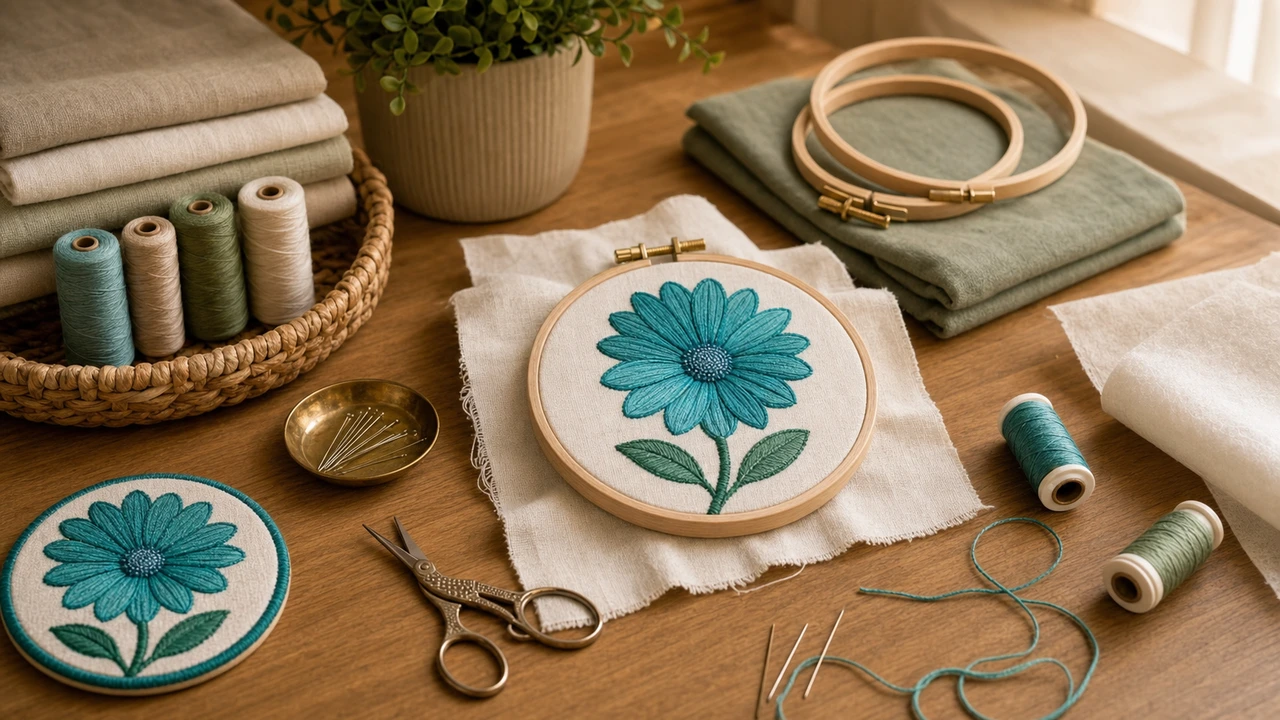
Beginner machine embroidery — hoops, thread, and supplies
Everything you need to start machine embroidery — covered in detail in this pillar guide.

What is in this guide

  1. The first 30 days — overview
  2. Your starter kit, fully itemized
  3. Fabric × stabilizer × thread matching
  4. Week-by-week 30-day plan
  5. Top 10 beginner mistakes (and how to avoid them)
  6. When you outgrow your beginner machine
  7. Recommended learning resources
  8. Frequently asked questions

01 · Overview

The first 30 days — the 4-step framework

Every successful beginner follows roughly the same path through their first month. Pick a machine, learn how files work, gather supplies, run a first project. The detail in this guide expands on each step — here is the framework.

01

Pick a starter machine

Your first embroidery machine determines the early ceiling on your designs. Most successful beginners start with a single-needle Brother home machine — the SE625 ($400-500, 4×4 inch hoop), the SE700 ($500-650, 5×7 with WiFi import), or the PE800 ($600-700, 5×7, embroidery-only). All three accept USB import, read PES files natively, and have the most beginner content on YouTube.

Two pitfalls to avoid: buying a 4×4-only machine and outgrowing it in your first month (5×7 is the sweet spot), and buying a commercial multi-needle machine ($3000+) as your first purchase — you will spend more time fighting the complexity than learning embroidery. See our first machine buying guide for the full comparison at each budget.

02

Understand embroidery files

An embroidery file is a digital blueprint of stitches, colors, and machine instructions. It is stored in a machine-specific format: PES (Brother), DST (commercial Tajima), JEF (Janome), VP3 (Husqvarna Viking), EXP (Melco/Bernina), or HUS (legacy Husqvarna). Your machine reads one or two of these natively — for Brother machines that is PES.

You do not need to draw embroidery from scratch as a beginner. Designs come from three places: purchased designs from marketplaces (where to buy), free design sites (curated list), or AI digitizing tools like StitchPilot.ai that convert any image into a machine-ready file in seconds. Most beginners buy a few designs while learning the machine, then graduate to AI or custom digitizing.

03

Get your starter supplies

The minimum viable embroidery kit beyond the machine is around $80-100 and covers your first 10-20 projects. You need: stabilizer (cut-away medium weight and tear-away medium, about $20-25 for starter rolls), 40wt polyester embroidery thread in a starter assortment of 20-40 colors ($25-40), pre-wound size L white bobbins ($15 for a tube of 25), embroidery needles in sizes 11 and 14 ($10), and a small pair of curved embroidery scissors ($10-15).

The next section breaks this down by brand and exact products. Avoid the common beginner mistake of buying regular sewing thread or sewing-machine needles — embroidery thread is finer, embroidery needles have a different eye and scarf, and using the wrong type causes constant thread breaks.

04

Run your first project

The ideal first project is a monogram on a kitchen towel or t-shirt — small (2-3 inch), forgiving fabric, low pressure if it goes wrong. Buy or download a single-color monogram design in PES format. Hoop the fabric with cut-away stabilizer (drum-tight, no wrinkles). Load the file via USB. Match the bobbin and top thread, then stitch and watch.

Your first project will not look perfect. That is fine — you are learning to read tension, hooping tightness, stabilizer fit, and design density all at once. Most beginners need 5-10 projects before the output is consistently good. Treat the first month as practice and use cheap fabric (Walmart kitchen towels, blank t-shirts from Hobby Lobby) until your fundamentals are solid.

02 · Itemized

Your starter kit, fully itemized

A realistic full machine-and-supplies starter is $480-870 depending on which machine you choose. Here is exactly what you need and where to spend more vs less.

Machine $400 - $700

The biggest one-time cost. Detailed recommendations:

  • Brother SE625 — $400-500. 4×4 hoop. Sewing+embroidery combo. Great learning machine but you will likely upgrade within a year as 4×4 limits most designs.
  • Brother PE800 — $600-700. 5×7 hoop. Embroidery-only (no sewing). The most popular beginner-to-intermediate machine on the market. Recommended for most beginners.
  • Brother SE1900 — $1000-1500. 5×7 hoop. Sewing+embroidery with more features. Worth it if you want both crafts in one machine.
  • Janome MC 500E — $2500-3500. 7.9×11 hoop. Embroidery-only, professional results. Best home machine before you need commercial.
Thread $25 - $40

40wt polyester is the industry standard. Buy a starter assortment:

  • Brothread 40-color starter set — $30. Great quality-to-price for beginners. Color codes printed on each spool.
  • Madeira Polyneon — premium, ~$3 per 1000m spool. Buy individual colors as you need them.
  • Isacord — premium polyester, similar to Madeira. ~$3 per spool.
  • Simthread — budget Amazon option, $20 for 40-color set. OK quality, fine for practice.
Needles $10 - $15

Embroidery-specific needles, not regular sewing needles:

  • Size 11 sharp embroidery — 5-pack for fine fabrics and small designs. ~$5.
  • Size 14 sharp embroidery — 5-pack, the workhorse size for most embroidery. ~$5.
  • Size 11 ballpoint embroidery — 5-pack for knits (t-shirts, jersey). ~$5.
  • Replacement cycle — change every 8-12 hours of stitching, or after every thread break. Needles dull faster than you expect.
Stabilizer $20 - $30

Stabilizer supports fabric during stitching and is the #1 thing beginners get wrong. Starter set:

  • Cut-away medium weight (2.5oz) — for knits, t-shirts, sweatshirts. 12 inch wide × 10 yard roll, about $12. Brands: Pellon SF101 (heavier), Sulky, OESD.
  • Tear-away medium weight — for wovens (denim, polos, canvas). 12 inch × 10 yard, about $10. Brands: Sulky Stiffy, Pellon 990F.
  • Water-soluble topping film — for terry/fleece to prevent stitch sinkage. Small pack, $8.
Bobbins $15

Use bobbin-specific thread, NOT your top embroidery thread:

  • 60wt or 90wt pre-wound bobbins — white is the most common since most embroidery is on light fabrics. Tube of 25 pre-wound bobbins, $12-18.
  • DIY winding — buy a 5000m cone of 60wt bobbin thread ($10), wind your own. Cheaper per yard but takes time.
  • Color matching — counterintuitive: match the bobbin to the FABRIC color, not your top thread. White on white fabric, black on black.
Software Free

You do not need expensive digitizing software to start:

  • StitchPilot.ai viewer — free, browser-based. Open any PES/DST/JEF/VP3/EXP/HUS file, preview stitches, check size and stitch count before stitching.
  • StitchPilot.ai converter — AI digitizing from any image. Skip the digitizing-software learning curve entirely.
  • Ink/Stitch (free) — Inkscape plugin for manual digitizing once you want to learn that.
Scissors and snips $15 - $20

For trimming jump stitches and removing stabilizer:

  • Curved-tip embroidery scissors — Gingher or Fiskars, $12-18. The curve lets you snip flush without damaging the fabric.
  • Small thread snips — $5-8. For trimming top thread between color changes.

03 · Reference

Fabric × stabilizer × thread × needle matching

The single most useful reference for new embroiderers. Match the row to the fabric you are working on. The wrong combination is the #1 cause of beginner frustration.

FabricStabilizerThread weightNeedleNotes
Cotton t-shirt (knit)Cut-away medium40wt polySize 11 ballpointCut-away stays in to support the knit through wash; ballpoint avoids damaging knit fibers
Polo shirt (pique knit)Cut-away medium40wt polySize 14 ballpointSimilar to t-shirt but slightly heavier hand
Sweatshirt (fleece-back)Cut-away medium + topping40wt polySize 14 ballpointTopping prevents stitches sinking into fleece
Terry towelCut-away + water-soluble topping40wt polySize 14 sharpTopping is critical or stitches disappear into loops
DenimTear-away heavy40wt polySize 16 sharpStrong needle pierces tight weave without bending
Canvas / duck clothTear-away heavy40wt polySize 16 sharpPre-wash and pre-stretch fabric before hooping
Silk / satinCut-away light60wt polySize 11 sharpFine needle is critical or you damage delicate fibers
FeltCut-away light40wt polySize 11 sharpFelt is forgiving — light stabilizer is enough
Hat / cap frontCap hoop + tear-away medium40wt polySize 14 sharpRequires cap hoop attachment, not flat hoop
Leather / faux leatherNo stabilizer needed40wt polySize 14 leather (wedge point)Test on scrap — holes are permanent
Quilting cottonTear-away medium40wt polySize 11 sharpPre-wash to avoid shrinkage post-stitch
Performance fabric (athletic)Cut-away light + tear-away topping40wt polySize 11 ballpointStretchy — needs both stabilizers to prevent distortion

04 · 30-day plan

Week-by-week, day-by-day learning plan

A concrete schedule for the first 30 days. Each week has a theme and specific day-level tasks. The goal is one new skill per day, not perfect output.

Week 1 · Unbox and learn the machine
  • Days 1-2 — Read the manual cover to cover. Watch the brand-specific YouTube unboxing/setup videos (Brother PE800 has dozens of good ones).
  • Day 3 — Practice running the machine motor with no thread or fabric, just to hear and watch it move. Learn where the start/stop button, color change, and emergency stop are.
  • Days 4-5 — Thread the machine top thread, wind your first bobbin, install it. Most beginners struggle here — pause and rewatch tutorials as needed.
  • Days 6-7 — Stitch a test square on scrap fabric (a small filled rectangle, 1-inch on a side). The goal is to see thread on fabric in your machine. Stop, study the result, take photos for later comparison.
Week 2 · First real project
  • Days 8-10 — Hoop a piece of scrap fabric. Run a free small design from the machine's built-in library or a free PES download.
  • Days 11-12 — Repeat on an actual t-shirt or kitchen towel. Use cut-away or tear-away stabilizer as appropriate. Save the result regardless of how it looks.
  • Days 13-14 — Try a monogram with a single letter. If the machine supports built-in alphabets, use those. Otherwise download a monogram design and edit the letter.
Week 3 · Color changes and intermediate skills
  • Days 15-17 — Run your first multi-color design. Pay attention to the color stop sequence — the machine pauses, you change the top thread, and resume. This is the moment many beginners feel they "have it".
  • Days 18-21 — Stitch on three different fabric types this week (cotton, polo, terry towel for example). Note how each behaves differently with the same design.
Week 4 · Trouble recovery and planning
  • Days 22-24 — Intentionally cause failures: run too dense a design, use the wrong stabilizer, deliberately set tension wrong on a test. Learn what each problem looks like so you recognize them later.
  • Days 25-28 — Try design size variations. Resize the same design to small (2-inch) and large (6-inch) and stitch both. Notice what works at each scale.
  • Days 29-30 — Plan your first "real" project — a gift for someone or a piece for yourself you actually care about. By now you should have enough fundamentals to execute.

05 · Pitfalls

Top 10 beginner mistakes (and how to avoid them)

These are the mistakes that derail beginners. Read them now, recognize them when they happen, and you will skip months of frustration.

01

Wrong stabilizer for fabric type

The #1 beginner mistake. Cut-away for knits, tear-away for wovens, water-soluble topping on terry/fleece. Using tear-away on a t-shirt is the classic cause of stitches looking warped after the first wash.

02

Hooping the fabric loosely

Embroidery requires the fabric to be drum-tight in the hoop — tapping the surface should sound like a snare drum. Loose hooping causes fabric pulling, registration drift, and puckered finished pieces.

03

Skipping the test stitch

Stitching directly on the final fabric without a test piece on scrap of similar material is asking for tension surprises. Two minutes of test stitching saves the expensive blank.

04

Wrong needle size for thread weight

40wt thread + size 14 needle is the safe default. 60wt thread needs size 11. Wrong combinations break thread constantly and the beginner blames the machine.

05

Top tension too tight (and not adjusting)

The machine's factory setting is a starting point. Different fabrics and threads need ¼-turn adjustments. Read the back of the stitches — too much top thread visible means top tension is too tight.

06

Using bobbin thread as top thread (or vice versa)

Top thread (40wt) in the bobbin produces bulky underside and constant thread breaks. Use 60wt bobbin thread in the bobbin — they are different products.

07

Buying free designs without checking quality

A poorly digitized free design will frustrate even an experienced embroiderer. Check stitch count and density before stitching — a 4-inch design with 60,000 stitches is over-dense and will tear fabric.

08

Trying complex designs first

Photorealistic portraits, dense filled designs, and tiny lettering all require fundamentals you do not have yet. Start with monograms and simple shapes. Build to complex over 3-6 months.

09

Not changing needles often enough

Embroidery needles dull every 8-12 hours of stitching. A dull needle causes skipped stitches, thread breaks, and fabric damage. Buy needles in bulk and change them on schedule.

10

Buying a 4×4-only machine and outgrowing it in a month

The Brother SE625 is great for monograms but limits most other designs. If budget allows, the 5×7 PE800 is the smarter long-term choice — you will not outgrow the hoop size in your first year.

06 · Next steps

When you outgrow your beginner machine

Most embroiderers upgrade their machine within 1-2 years. Here are the signs you are ready and the typical upgrade paths.

Signs you are ready

  • You constantly run into hoop size limits — your designs do not fit the 4×4 or 5×7 hoop.
  • Multi-color designs feel like a chore — you are spending more time changing thread than stitching.
  • You are embroidering commercially or for a side business — multi-needle pays for itself around 50 pieces a week.
  • You want larger fields (8×8, 10×10, 12×18) for jacket backs or large logos.
  • You want faster output — commercial machines run 1000+ stitches per minute versus 500-800 on home machines.
  • You want unattended runs — commercial multi-needle machines can stitch a full design without you changing thread.

Typical upgrade paths

  • Home → bigger home. Brother SE1900 (5×7 + 25 sewing features), Janome MC 500E (7.9×11 hoop), Brother Skitch (5×7 with auto color sensing). $1500-3000 range.
  • Home → semi-commercial multi-needle. Janome MB-4 (4-needle, home-friendly footprint), Brother PR680W (6-needle, popular for small shops). $4000-7000 range.
  • Semi-commercial → full commercial. Tajima (10-15+ needles, industrial), Barudan, Melco Amaya. $10,000+ — only worth it if you have steady commercial volume.

07 · Resources

Recommended learning resources

Curated sources for designs, tutorials, and community. These complement this pillar guide and help you go deeper on specific topics.

Design sources

  • Embroidery Library — large catalog, mid-tier prices, good for beginners (paid)
  • Designs by JuJu — well-known beginner-friendly designs, mid-tier prices (paid)
  • Etsy — vast selection, mixed quality, check reviews carefully (paid)
  • Creative Fabrica — subscription model, includes embroidery alongside other crafts (paid)
  • /guides/free-embroidery-design-websites — our curated list of legitimate free sources

YouTube channels

  • Embroidery Legacy — well-produced beginner tutorials
  • Designs by JuJu — videos on their machine and design workflow
  • AllStitch Embroidery Supplies — supply-focused tutorials
  • The Embroidery Coach — business and pricing-focused content

Communities

  • Reddit: r/Embroidery — general; r/MachineEmbroidery — machine-specific
  • Facebook groups: "Machine Embroidery Beginners", "Brother Embroidery Machine Users"
  • StitchPilot.ai feedback — share what you make and get advice on file issues

Frequently asked questions

How much does it cost to start machine embroidery in 2026?

Realistic all-in: $500-870. A beginner machine is $400-700 (Brother SE625 or PE800), plus a starter kit of stabilizer, thread, needles, bobbins, and scissors at $80-100. Ongoing material costs are $1-3 per typical project.

What is the easiest embroidery machine for beginners?

Brother PE800 ($600-700) — 5×7 hoop, embroidery-only, the most popular beginner-to-intermediate machine. The Brother SE625 ($400-500, 4×4 hoop, sewing+embroidery combo) is cheaper but you will outgrow the hoop size quickly. Both have the largest beginner community and the most tutorial content online.

Do I need to know how to sew to do machine embroidery?

No. Machine embroidery is a distinct skill — the machine stitches automatically from a digital file. Sewing knowledge helps with finishing tasks (hemming, attaching patches), but the embroidery itself is hooping the fabric, importing the file, and pressing start.

Can I make my own embroidery designs?

Yes, via digitizing. Three paths: (1) learn digitizing software like Wilcom Hatch ($1500+), Embrilliance ($150-500), or the free Ink/Stitch — months of learning curve; (2) use AI digitizing tools like StitchPilot.ai that convert any image to a machine-ready file in seconds; (3) buy designs and learn editing rather than full digitizing. Most beginners start with #3, graduate to #2, and only learn #1 if running a commercial digitizing business.

How long does it take to learn machine embroidery?

First successful project: week one. Reliably good output (consistent quality across fabrics): 2-3 months. Comfortable troubleshooting (thread breaks, tension issues, fabric problems): 4-6 months. Mastery (running commercial work, fast turnaround, complex designs): 1-2 years of regular use.

Is machine embroidery profitable as a side business?

Yes, but margins depend on volume and pricing discipline. Typical embroidery shop pricing is $0.50-1.00 per 1000 stitches plus a setup fee. A 10,000-stitch logo retails $8-15. To clear $1000/month profit you need roughly 100-150 pieces a month at consistent pricing. See /guides/how-to-start-embroidery-business and /guides/how-to-price-embroidery-work for the full breakdown.

Can I do machine embroidery on hats and caps?

Yes, but you need a cap hoop attachment, not a flat hoop. The cap hoop holds the front panel of the hat flat against the embroidery field. Most home embroidery machines support cap hoops as a separate accessory ($60-150). Hat embroidery is also a high-margin commercial niche — see our hats and caps use-case page.

What is the difference between embroidery and quilting?

Embroidery decorates fabric with thread designs (logos, monograms, art). Quilting joins multiple fabric layers with a stitched pattern, usually decorative but structural. Some embroidery machines can do quilting embroidery designs, but the workflows and aesthetic are different crafts.

Ready to try?

Skip the digitizing software learning curve

StitchPilot.ai converts any image to a machine-ready PES, DST, JEF, or VP3 file in seconds. The fastest way to make a custom design as a beginner.

Open the workspace →