Check your machine's manual
The single fastest way to choose: open your machine's manual and look for "supported file formats". Most machines accept one or two formats natively; everything else needs conversion.
 StitchPilot.ai
Format comparison
DST is the de facto commercial embroidery standard, supported by virtually every multi-needle commercial machine. JEF is the native format for Janome embroidery machines. They overlap in capability but target different machine ecosystems. This guide compares them side-by-side and explains how to convert between them when you need to.
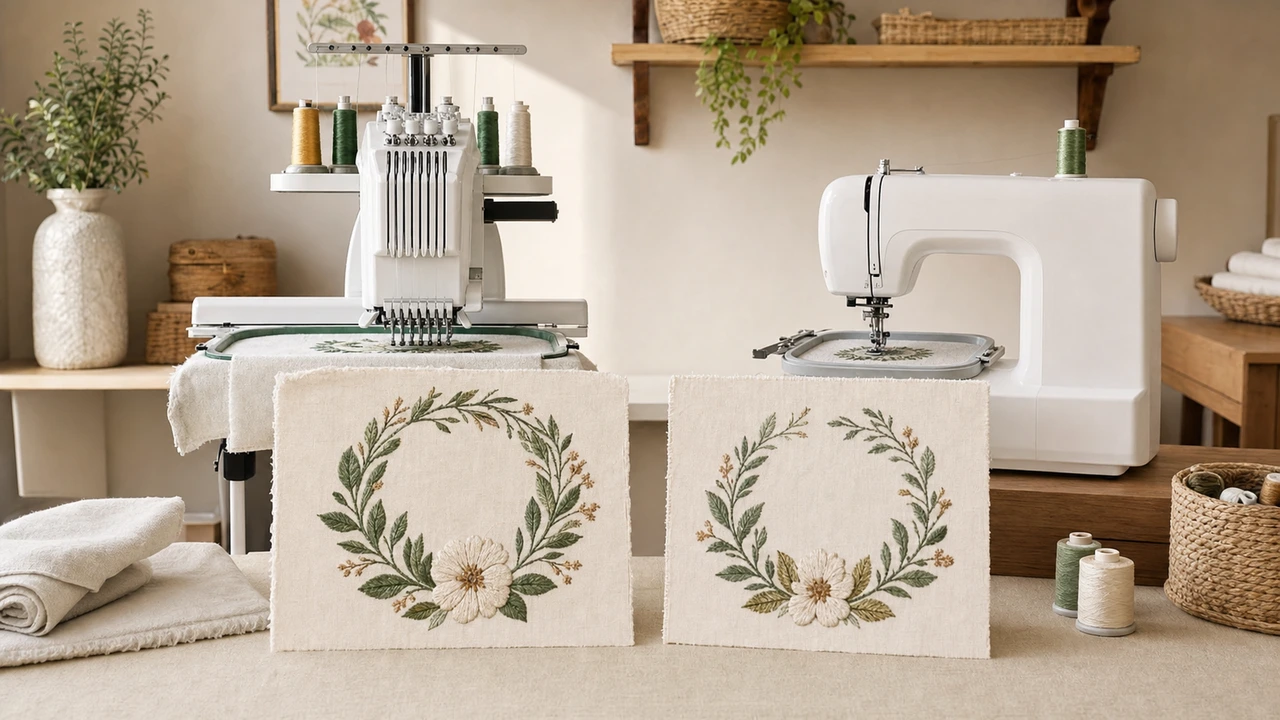
How to choose
The single fastest way to choose: open your machine's manual and look for "supported file formats". Most machines accept one or two formats natively; everything else needs conversion.
DST is the right call when you are working in the Tajima ecosystem. JEF is the right call for the Janome ecosystem.
If you are sending designs to multiple machines or production partners, DST (Tajima) is the most universally accepted commercial format. Otherwise pick the native format for your primary machine.
StitchPilot.ai converts between DST and JEF in the browser. Open the file, choose the target format, export. No need to keep multiple desktop tools installed.
When to choose DST
DST is the natural choice in these contexts:
When to choose JEF
JEF is the natural choice in these contexts:
DST vs JEF — common questions
Neither is "better" — they target different machine ecosystems. DST is the native format for Tajima; JEF for Janome. Pick the one your machine reads natively.
Yes. StitchPilot.ai converts between DST and JEF in the browser. The same source design can be exported to either format without re-digitizing.
Modern conversion between DST and JEF preserves the stitch sequence and color order. Some format-specific metadata (such as thread brand codes) may be lost; the stitches themselves are preserved.
DST files use the .dst extension. JEF files use the .jef extension.
Only if you produce on both ecosystems. If your work targets only one machine family, stick to its native format and convert only when sending out for production elsewhere.
Skip the format decision
Upload once, export to DST, JEF, or any other major embroidery format from the same workspace.
Convert to either format →